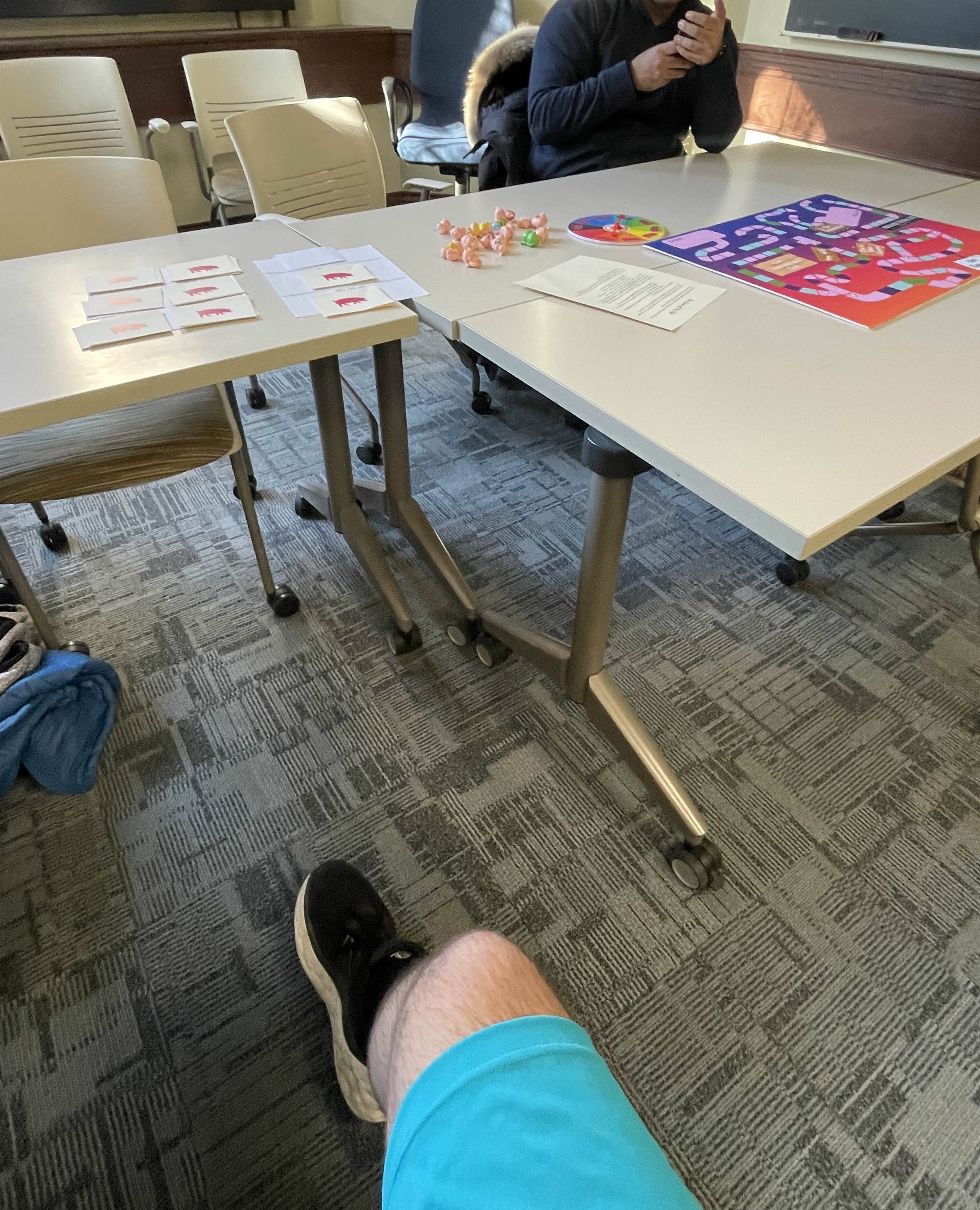
The Game Of Pig Life
Pig History is one of the greatest classes I’ve ever taken.
That’s not an acronym: it was a real class, taught by a pig historian, about the history of pigs and, more importantly, understanding human history through pigs. Ask me about the details sometime, it’s fascinating stuff, but the important part is the final project.
It was completely open-ended, a dangerous thing to let me have. So, I pitched “The Game of Pig Life.” Read the original proposal on the right.
-
Pigs have changed substantially over the past 10,000 years in everything from geography to domestication status (back and forth) to extensive physical changes. To capture these messy and branching paths, I propose a version of the Game of Life tracing the history of pigs and their relationship to people. In Game of Life fashion, players will spin a spinner and move across a board, chronologically moving through the history of pigs. Players will make choices, then, as a bloodline of pigs, and deal with the consequences for their line as a result. One choice, for example, may be deciding whether or not to become domesticated at a certain point in time (or even a certain place). However, pigs defy easy classification and are anything but linear, generally existing as multiple different things at once. To that end, players may have the choice to nearly freely switch paths and break out of domestication, returning to the wild path. After all, pigs are at any given time less than one generation from going feral again. I intend for the game to function almost more as performance art than as a game ‒ who is the player to say they’re in complete control of where the bloodline goes, and what these pigs do? Random spaces may force the player to swap paths or radically change the game state in ways much more dramatic than the actual Game of Life. I imagine most endings of the game will be variations on the same “bad ending,” that being that your species has been targeted for systematic slaughter by humans on an industrial scale. Whether it’s being confined to CAFOs or hunted by machine gun-wielding helicopters across the American south, the timelines are generally dire no matter what the player does, or how much agency they feel they have. The game will also speak to the broader unpredictability of history, with fewer better representatives for this dynamism than pigs.
Ok, great, so what does that actually mean?
Good question. I eventually settled on the following:
The Game of Pig Life
The Game of Pig Life is played with 4 players. To determine order, everyone spins once. The play order is the order of those spins, highest to lowest.
You play as a bloodline of pigs through history, so each space represents a jump forward in time. Your line starts with 100 pigs. Take turns spinning to move 1-10 spaces.
Colored spaces have the following effects:
Purple spaces are checkpoints. Passing or landing on these doubles your current population size!
Blue spaces have cards with one-time modifiers to your population size!
Green spaces have cards with permanent modifiers to your line!
The different paths at junctions have different kinds of cards and modifiers. Unless otherwise stated, you can swap freely between paths if you spin high enough. You may do so after you spin (but before moving), and it does not consume your turn. Further in the game, swapping between paths requires higher spins.
In the first junction, a spin of 3 or higher is required to swap.
In the second, a spin of 5 or higher is required.
In the third, a spin of 7 or higher is required.
Pigs root on the space they land on! Every blue and green space only has one card on it, so once a player has landed there, the next player to land there will get nothing. Rooting does not affect purple spaces. If you land on a rooted space, your pigs starve a little. -10%
If you land on the same space as another player, you intermingle! Average your two populations.
So, I got to work!
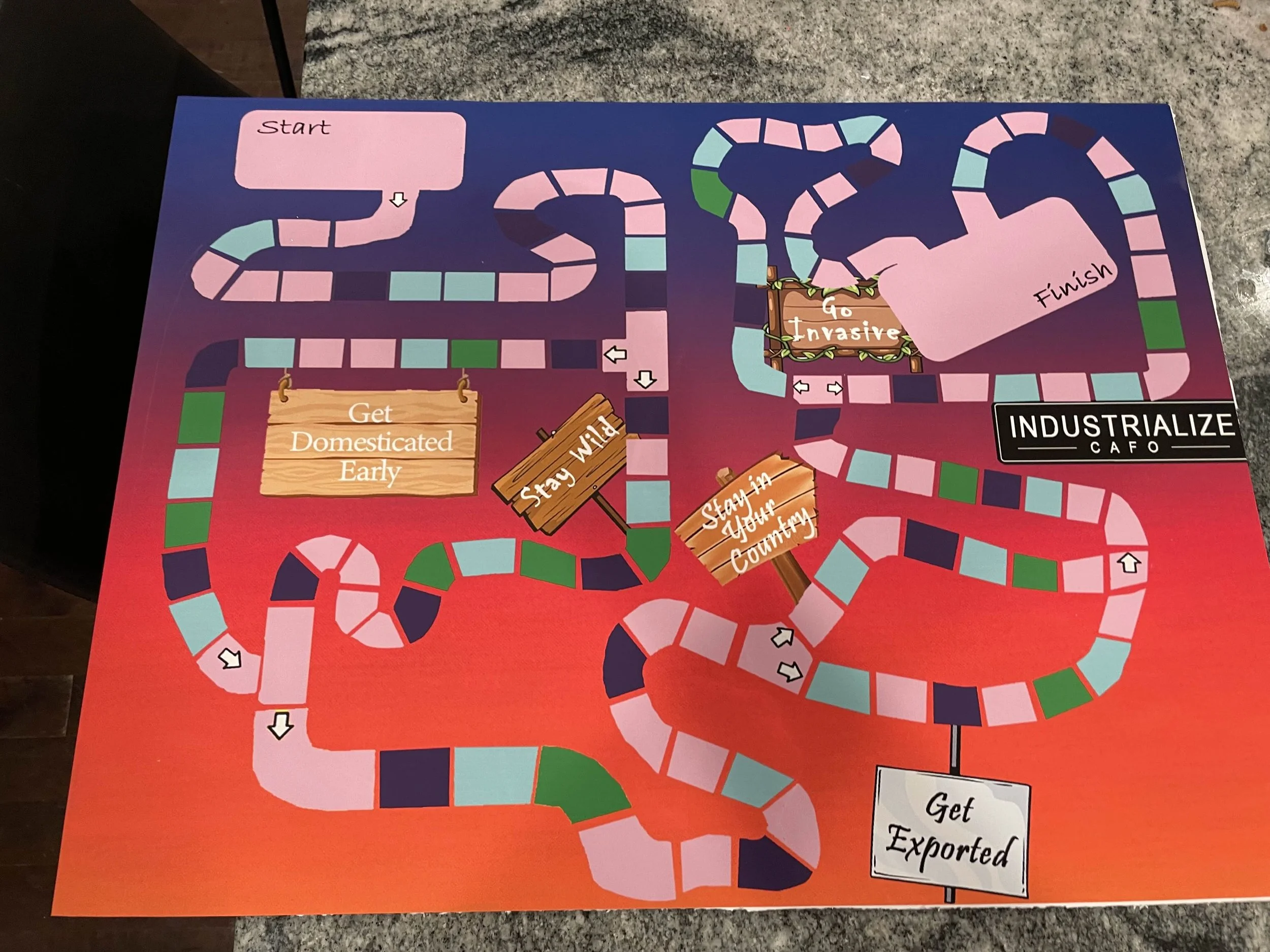
This board is designed very tactically to let players make use of the swapping mechanic, and also balances green cards versus population growth.
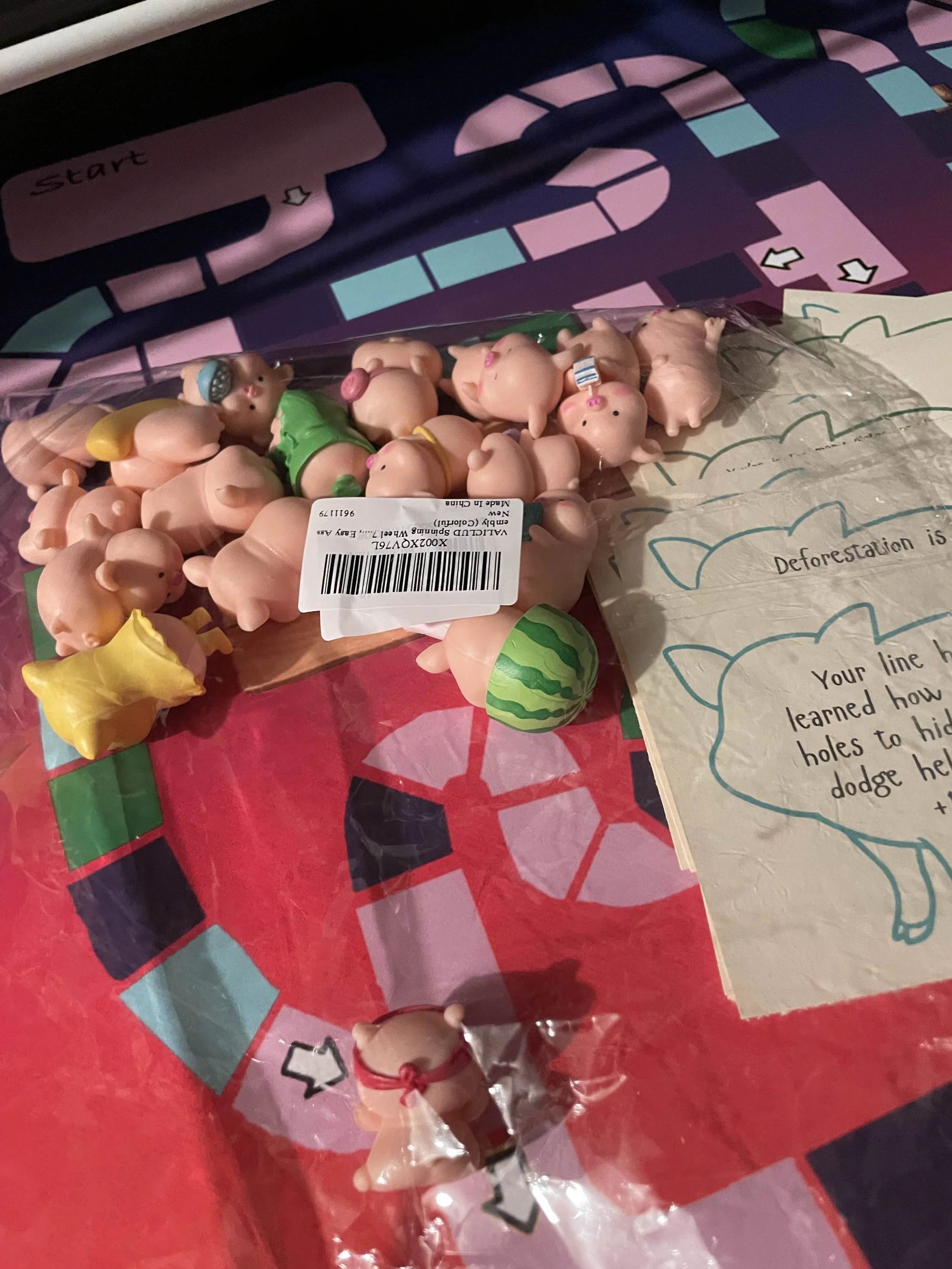
I bought these adorable pigurines!
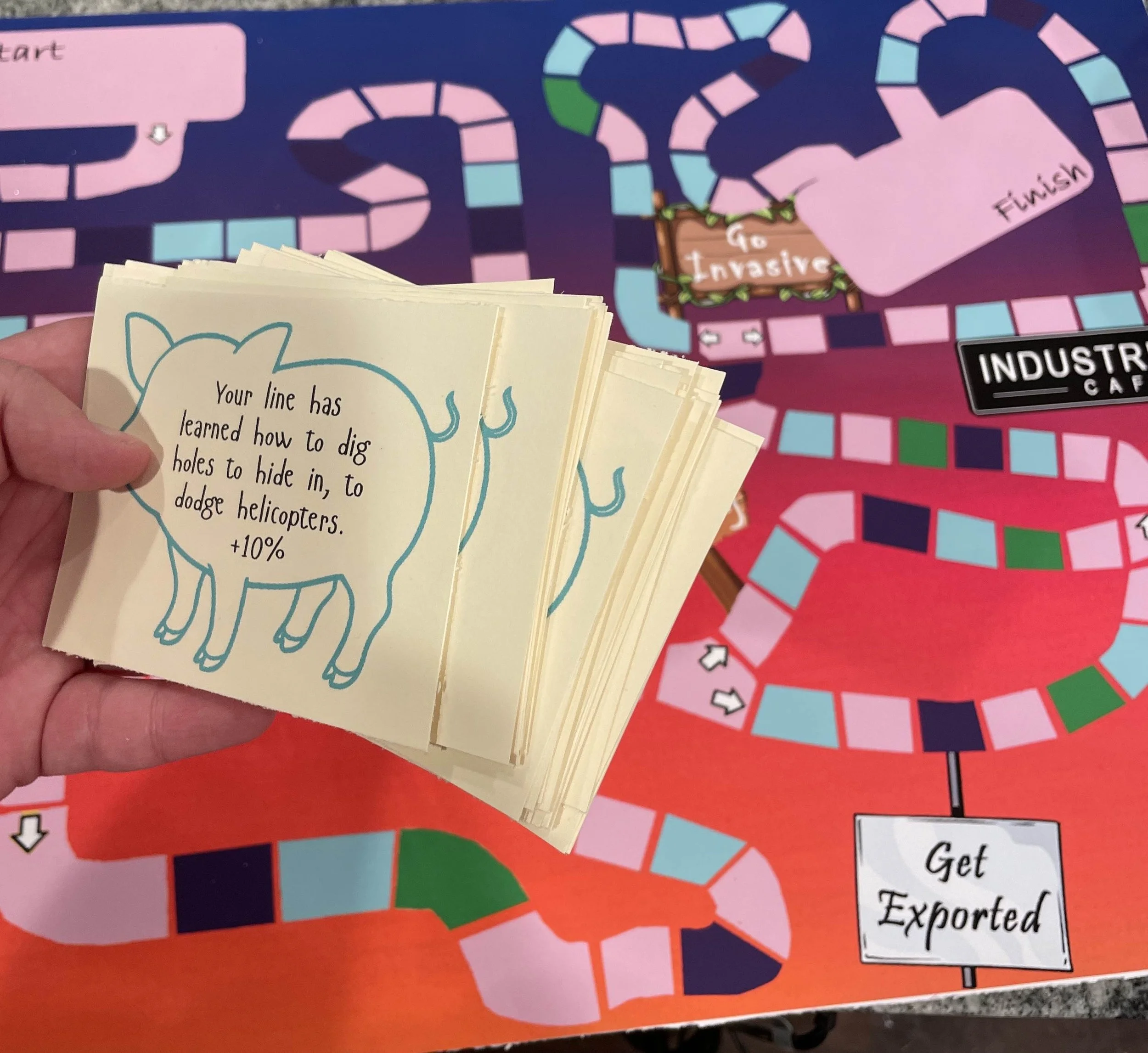
Since every blue and green space requires a unique card, I ended up creating over 30 different cards for this game! You can read them all below:
-
Beginning
Your line has expanded into a new territory! +25%
Much of your line got caught in a forest fire! -30%
Your line walked into a perfectly good, recently-burned forest. Not many other animals can compete for your food sources! +15%
A heat wave has hit your line’s territory, and there’s nowhere near enough mud around. -20%
First split
Civ
Blues:
Your line has been caught rummaging in the fields a few too many times. -15%
There’s so much food in these villages. So much food. +25%
More of your pigs are getting kept alive for manure production! +15%
Your line has been artificially bred to have more piglets. Will it stay that way? Who knows. +20%
Green:
Your line is considered sacred. Nullify any future cards that target your line for direct extermination by people, unless your line is also considered dirty.
Your line is considered dirty. Unless your line is also considered sacred, add another -10% of population impact to all future cards that target your line for direct extermination by people.
People have started bringing your line into their homes! Due to this backup reserve of pigs (and your line being generally considered useful), cards cannot lower your population by more than 20% at a time.
Wild
Blues:
Your line has gotten pretty picky about the kinds of foods they like… and there’s not too much of those around. -10%
Deforestation is messing with your line’s territory and food sources. -25%
Green:
Your line likes being wild, and would prefer to stay that way. The threshold for swapping out of the Domesticated and CAFO paths is lowered by 2.
Your line is a reservoir host for some nasty pathogens humans would rather not deal with. Every time you land on a blue space, spin the spinner. If it’s even, -10%
Your line has gained a more aggressive, unwieldy temperament. Every time you spin a 10, go back 3 spaces (This cannot reactivate population doubles, but you can grab cards on both spaces if they have them. This includes when spinning to swap paths, and takes place before you swap).
In Between 1st and 2nd
Blue:
There’s a manuring crisis abound, and only your line can fix it. +15%
Is your line really that useful? Humans are starting to breed lines besides yours together, and targeting you in the process. -30%
Green:
The word “pork” was just invented to separate the concept of your line’s flesh from the tasty food it can be used for. If your line was considered sacred before, it isn’t now. Your line is now also destined (forced) to take the CAFO path, and the threshold for swapping is raised by 1.
Second split
Stay in your country
Blue:
Another breed in your country is taking off in popularity, and seems on first glance to be much more useful to humans. -25%
“Pig” becomes a high compliment in your country. Your line is, for now, targeted much less and bred much more. +20%
Green:
Your line is now considered a national breed! The people love you and will go above and beyond for you. Add an extra 5% to all future cards improving your population bonus.
Get exported
Blue:
The citizens of this new country haven’t taken kindly to the arrival of your line, and are targeting you on sight. -20%
Farmers have started to realize your potential as a line. +25%
Green:
You’ve been interbred here but still exist at home. Are you one line? Two? Two. Gain a second figurine, on the other path. Copy your population value to it, though it grows independently, and you spin separately for it too. At the end, average how they both do.
In Between 2nd and 3rd
Blue:
We must feed the war effort! What do you mean, “which war?” -35%, but you’ll bounce back: +35% on the next blue or green space you land on.
War has come to your land. Damn. -25%
Green:
Your line has become especially opportunistic. Take a green card from each player you pass (They may flip and shuffle their cards, but you may choose which to take).
Third Split
Industrialize → CAFO
Blue:
PRRS has become widespread in your line. -30%
African swine fever has come to your line. Global agribusiness isn’t going to accept that. -50%
Big Tech has taken an interest in pig farming, and has chosen your line. +10%
AI has come to pig farming, but not the slaughterhouse. +45%
Green: Deus Ex Scrofa. Your country doesn’t want a pork miracle. It needs a pork miracle. It needs you. Double all spaces affecting population growth, including both purple checkpoints and blue spaces.
Go Invasive, Roam Free
Blue:
Hunters love you. In fact, they’re bringing your line around from area to area just to get even more of you. +30%
You have been declared a national nuisance. -20%
Your line has learned how to dig holes to hide in, to dodge helicopters. +10%
New sleep bombs that coagulate your blood have been developed. -15%
Climate change has made some resource-rich areas of the globe newly habitable for your line. +25%
Green:
You’re in too many states, provinces, countries, territories… you are uncountable. Not infinite, but unknowable. Replace your population total with a “?” Ignore all future blue and purple spaces: you root them, but they do not affect your population.
The game also has some secret rules…
The more times you swap paths, the more likely it is that the game will just make choices for you… you have embraced true pig chaos and the game will slip out of your hooves
Swap once: rolling an X forces you to swap
Swap twice: rolling an X or Y forces you to swap
Swap thrice+: 5 different numbers force you to swap
These numbers are decided on, in secret, by everyone else in the room
For each swap after, members of the room can change which numbers cause a swap, add, or remove a number
The same action can not be done twice in a row
“Winner” isn’t clearly defined – it must be very clear that the person with the most pigs didn’t “win,” they just have the most pigs.
These rules are where the game goes from “game” to “performance art.”
Playtesting went great, and the professor loved it so much she asked if I wanted to keep working with her on refining it and turning it, perhaps, into a real game!
I would be insane to turn down that offer, so, stay tuned…